Introducing San Francisco History of the Tower of London Grand Central Station Visitors Guide
Showing posts with label health. Show all posts

Tuesday, January 1, 2013


Photo by: Thinkstock
Everybody has habits that they don't like. But breaking them is tricky because you often do them without even realizing it. That's why the first step to banishing those behaviors is recognizing that you do something irritating in the first place. Then, replace that practice with something that serves a similar purpose. Eventually, that'll become a habit. Here are other expert strategies for stopping some popular practices. Photo by Thinkstock.

1. Biting Your Nails
If you hide your hands because you've gnawed your nails to nubs, it's time to change that. Identify what you do before you bite your nails, suggests James Claiborn, PhD, co-author ofThe Habit Change Workbook: How to Break Bad Habits and Form Good Ones. Do you search for uneven or jagged edges, and then bring your hand to your mouth? Instead of moving a finger toward your face, clench your fists. Continue clenching them for a couple of minutes until the urge to bite your nails disappears. When you feel you've made progress changing this behavior, treat yourself to a well-deserved manicure

2. Knuckle Cracking

Even though you may love the sensation, you probably want to stop as a courtesy to people who don't enjoy that grating sound. Dr. Claiborn recommends relying on a "competing behavior," a.k.a. doing something instead of cracking your knuckles. Punching your other hand or fanning out your fingers will prevent you from going to town on your knuckles. To crack down on cracking for good, keep a record of your successes-when you substituted another behavior for your bad habit-and your relapses. Figure out why you slipped, and you'll be closer to a knuckle-cracking-free life.

3. Gum Snapping Again, you may enjoy that gratifying sound, but it's irritating to everyone who can hear it. So ask yourself how important it is to keep chewing gum, says Dr. Claiborn, and consider giving it up altogether. With a stick in your mouth, it's tough to resist snapping it. If you'll miss the pleasurable process, try deep breathing or a relaxation exercise-it may calm you just as effectively. On the other hand, if you chew gum to freshen your breath or stave off hunger, pop in a mint instead.

4. Sleeping in Your Makeup
You're just so tired by the time you go to bed, you can't even think about scrubbing your face. Keep cosmetic-remover wipes on your nightstand, so you can at least wipe off your makeup before you hit the hay, says Yael Varnado, MD, who answers health questions at AskDoctorV.com. Or create a bedtime ritual of using a face-washing product and moisturizer you love while soothing music plays. Need more motivation to remove makeup at night? Sleeping with it on can cause acne and wrinkles, because it dries out skin around your eyes.

Related: Discover 75 timeless beauty tips. 

5. Interrupting 
You're eager to share your thoughts, but if someone else is speaking, you've got to bite your tongue (unless you want people to think you're rude!). Focus on listening, says Dr. Varnado. The more intently you hear someone out, the less you'll feel the urge to interject. "If the speaker pauses to take a breath or collect his thoughts, don't use that as a window to speak," she adds. Instead, breathe deeply, count to ten in your head and reflect on what the speaker said. You might also ask a pal to tactfully remind you of your goal when you lapse and celebrate your successes with you.

6. Noisy Eating You're aware you make sounds while you munch, but aren't sure why. Tape-record yourself to isolate whether you hum, click or make sucking noises with your tongue. Finding the specific sounds helps you focus on the solution, which could include changing where you keep and how you move your tongue during meals, chewing more slowly, chewing smaller pieces or keeping your mouth closed while eating (which is always a good idea in front of company).

7. Being Late Conquering this habit requires a compelling reason to be on time for appointments, says Ken Lindner, author of Your Killer Emotions. Ask yourself a few questions: Do you respect other people's time? Do you want to appear to be rude? Or would you like to be perceived as thoughtful and professional? When you decide to change, start by visualizing your arrival at an event five to ten minutes early-feels good not to annoy others, right? Or try writing down appointments 15 minutes before the scheduled time to ensure your promptness.

8. Reading Over Someone's Shoulder

That invades their privacy! Putting yourself in that person's shoes could help you quash your curiosity, says Lindner. Imagine how you'd react to someone looking over your shoulder. Now picture that person calling you out in a room full of people. That kind of embarrassment will most likely push you to want to stop this behavior. If it's not enough, sign up for a free habit-changing site, like HabitForge.com, which emails you daily to see how you're doing.

Related: Check out these 9 bad habits that are good for you. 

9. Talking Loudly on Your Cell Phone

Consider what might happen if your conversation leaked to the wrong person or got posted on Facebook or Twitter. Would you lose a big client or a close relationship? When you're in public, you have no idea who might be listening or where bits and pieces of your conversation might end up. To remind yourself to take or make calls privately, write a trigger word or phrase on your smartphone in a place you'd see all the time, says Lindner. His word is "Mario Lopez," one of his biggest clients. 

10. Fidgeting

Moving around because you're anxious can be seen as a sign of weakness, says Lindner. To prevent that perception, consciously think about what you'll do with your hands in every situation before it happens. If you're standing, put your hands at your sides and imagine they're glued there so you can't move them. If you're seated at a table, place your hands on your knees under the table or fold them on top of the surface. Concentrate on not moving them until you need to use one.

(Reuters/Kevin Lamarque)(Reuters/Kevin Lamarque)
Secretary of State Hillary Rodham Clinton is "making excellent progress" recovering from a blood clot in her head that was discovered during a medical examination, her doctors said Monday. But Clinton remains hospitalized until a proper medication level is established, they said.
A day after announcing that Clinton had been admitted to a New York hospital for treatment of a blood clot related to a concussion she sustained, State Department spokesman Philippe Reines on Monday released a statement from Drs. Lisa Bardack and Gigi El-Bayoumi offering further detail on  Clinton's condition and how it was first diagnosed.
"In the course of a routine follow-up MRI on Sunday, the scan revealed that a right transverse sinus venous thrombosis had formed. This is a clot in the vein that is situated in the space between the brain and the skull behind the right ear. It did not result in a stroke, or neurological damage," the statement said.
To help dissolve this clot, her medical team began treating the Secretary with blood thinners. She will be released once the medication dose has been established," the statement continued. "In all other aspects of her recovery, the Secretary is making excellent progress and we are confident she will make a full recovery. She is in good spirits, engaging with her doctors, her family, and her staff."
In mid-December, the State Department announced Clinton had suffered a concussion after fainting at home. She has not been seen publicly for several weeks, but was scheduled to return to work shortly.
Clinton is expected to step down from her post later in January. President Barack Obama has name Massachusetts Sen. John Kerry as his choice to succeed Clinton.

Wednesday, December 12, 2012


Twice a week, The Chronicle features a local home on the market that caught our eye for its architecture, history or character. 
Address: 1234 Howard St., Unit 4B, San Francisco.
Asking price: $1.08 million.
Description: A streamlined, minimalist design characterizes this ultramodern loft in San Francisco's stylish South of Market neighborhood. Exposed ductwork and trusses decorate the luxury building, which also features floor-to-ceiling windows and open floor plans. The building's innovative style can be noted from the street. A glass facade coupled with anodized aluminum helps filter light into the loft throughout the day. Residents can control the metal louvers on the building's exterior, allowing its look to change during daylight hours. The loft's two bathrooms and two bedrooms are separated from the living room and kitchen by partitions. A soaking tub is the centerpiece of the European master bathroom; the master bedroom is located at the rear of the loft. Bulthaup cabinetry and Sub-Zero and Miele appliances complement the kitchen. A European shower-sink, toilet and shower are hidden behind a heavy glass door in the unit's second bathroom.
Don't miss: Stylish and contemporary features throughout the loft; the austere design enabling residents to put their own spin on their living space.
Built: 2007.
Size: Two bedrooms and two bathrooms, 1,295 square feet of living space.


Let's momentarily put aside the grumbling about the state of Syrah (still ... complicated) and the esoteric nature of Grenache (even if it's the basis of all those Chateauneufs du Pape) and just take a moment to enjoy how well the inspirations of southern France have taken hold on the West Coast.
Taken hold? Or have they been here all along? It appears that Syrah, Mourvedre and many others have been in California soil for a long time - even if no one could quite remember, in the years after Prohibition, that they were here.
No matter. These are grapes custom-fit for the state's climate, although Washington certainly is in the game in a big way, too. And as Grenache finds ever more partisans, the full inspirations of the Rhone are evolving into something with a very promising future.
2010 Bokisch Vineyards Clements Hills-Lodi Garnacha ($18, 14.5% alcohol): For all their Spanish inspirations in Lodi, Markus and Liz Bokisch continue to show the beauty of Grenache near the delta, in this case from a planting sourced to Rioja vine selections. The young vines, on volcanic, loamy soils, yielded a wine with more backbone, surprising for the vintage but with a gutsy charcoal edge, plus robust strawberry and dried apricot.
2010 Skinner El Dorado Grenache ($26, 14.8%): Winemaker Chris Pittenger continues to show the beauty of the foothills at this upstart label. The Grenache hails from two estate parcels plus two notable sites, Sumu Kaw and Fenaughty, at 2,500 and 2,850 feet, and the 2010 shows a particular perfume: iris, cedar and strawberry blossoms to match its deep berry flavors and a stony side.
2010 Failla Estate Sonoma Coast Syrah ($62, 13.9%): Ehren Jordan's dry-farmed estate parcel on the very edge of the coast never fails to deliver a powerhouse, and it's no different in this cooler year. Fermented all with whole clusters and a healthy dose (40 percent) of new oak, it's as dramatic as ever, full of candied lavender, green peppercorn, black olive, layered raspberry and wild blueberry. It smells like the best part of a coastal thicket, with an intensity that might wink at the Rhone but is unabashedly California.
2010 Gramercy Cellars Walla Walla Valley Syrah ($55, 13.9%): While you could easily be in bliss with Greg Harrington's 2009 Cabernet or his Lagniappe Syrah, his latest interpretation of Walla Walla's stony ground is deep, stunning and full of sweet spice. The inky blueberry fruit and briny tones are quintessential Washington, and its layers are dense without being outsized.
2010 Bonny Doon Vineyard Clos de Gilroy Central Coast Grenache ($18, 13.1%): The name of Randall Grahm's tribute to Grenache is a bit of a geographic shuffle, as the fruit currently comes from Soledad and Greenfield. But with a bit of Cinsault and Syrah, it shows both brooding, tar-like aromas and the bright fruit of Grenache. The blackberry and plum flavors make it instantly appealing.
2009 Landmark Sonoma Valley Grenache ($25, 13%): Even amid the success of its lavish Chardonnay, this Sonoma Valley winery, now owned by Fiji Water owner Stewart Resnick, has bet big on a Rhone inspiration. This young-vine example proves their wisdom, with its warm coffee and nutmeg aromas and surprisingly delicate berry and pomegranate fruit. Subtle and fulfilling.
2010 Sandler Connell Vineyard Bennett Valley Syrah ($20, 11.6%): A great example of Bennett Valley being a sweet spot for this grape. Winemaker Ed Kurtzman (August West) tapped an otherwise Pinot-dominant site near Santa Rosa's Grange Road for a version that's racy and packed with white pepper and sandalwood aromas, plus wild blueberry fruit and a chewy side perfect for the table.
2009 Peay Les Titans Sonoma Coast Syrah ($47, 13.5%): In a year with standout Pinot Noir and Chardonnay, the Peay brothers and winemaker Vanessa Wong have come up with a version of powerful Syrah from their Annapolis estate that trumps those other grapes. An inky density, with fine black pepper and leather, and a sleek, but ripe, blackberry fruit that's edged by black-olive and herb savoriness. A stylish, perfect expression of coastal California Syrah.
2011 La Clarine Farm Cedarville Sierra Foothills Mourvedre ($22, 11.7%): Hank Beckmeyer offered two exceptional Mourvedres from the foothills (Sumu Kaw being the other), but this late-picked bottling, from granitic soils at around 2,500 feet elevation near Fair Play, is downright explosive in its aromas: bay leaf, wild sage and aniseed, matched by bright cranberry and pomegranate. Mourvedre doing a delicious impersonation of Jura wine.
2009 Buty Rediviva of the Stones Walla Walla Valley Red ($60, 13.8%): From winemaker Caleb Foster, this might be Washington's quintessential wine. Mostly Syrah, with a bit less than one-quarter Cabernet, this leads with Syrah-like pungency: intense pepper spice and roasted game, with a Cabernet camphor accent and inky fruit that shows the warmer vintage. Deep and almost contradictory in its identity, and yet completely a sign of all the good things from the Northwest.
2009 The Ojai Vineyard Solomon Hills Vineyard Special Bottling Santa Maria Valley Syrah ($65, 13%): Adam Tolmach is having some fun with this site along Highway 101 outside Orcutt. This is fancy stuff, but it's also a tribute to Tolmach's love of the northern Rhone. Tapping a special block, he pulls off verdant aromatics - bay leaf, green peppercorn - that are matched with ripe blackberry fruit, glossy cured black olive, a subtle touch of oak and licorice warmth. An amazing benchmark for Santa Barbara.
2009 Wind Gap Sonoma Coast Syrah ($36, 12.6%): This wine is a library of Pax Mahle's greatest hits. From the Nellessen and Majik vineyards he used in his Pax Wine Cellars days, plus the Armagh vineyard, this is the quintessence of edgy coastal Syrah. Aged in old oak and fermented with whole clusters, it brims with big, warm spice on the nose: coriander, bacon fat, oily black olive and plum skin. It's daring but never austere, with gorgeous blue fruit and minerality.


Occupation: Referral coordinator at A Home Within, and barista at Sweet Inspiration Bakery.
Activity: Walking meditation.
Where do you do walking meditation? I walk the labyrinths (both indoor and outside) at Grace Cathedral every weekday after work. I start at the beginning of the labyrinth and, usually at a slow pace, make my way toward the center. I concentrate on my breath and on my walking. Once I reach the middle, I usually try to clear my head; it's often a time of gratitude for being able to be present with myself in this way. I walk back out the same way, concentrating on my breath and walking. I usually do the outside labyrinth first and then move inside, take off my shoes and do it all over again.
Benefits: The routine and ritual of it is important. I dedicate this time to being with myself and wherever I am at the time, with no distractions. My job, at times, can be intense, and walking the labyrinth after work is a great way to separate my work and life modes. I get to feel my body physically move toward something, even as I try to empty myself. It's a very grounding experience. It's just me, my breath and my body, no matter who else is around. I love the labyrinths at Grace, especially since I can choose between indoors or outdoors, and I get to be part of the city (there's a great view, and the grounds, as well as the buildings, are beautiful) but separate enough from the chaos of it.
Info about Grace Cathedral labyrinths: The outdoor labyrinth is made of terrazzo stone and is located to the right of the cathedral doors. The indoor labyrinth is open during cathedral hours, which are normally 7 a.m. to 6 p.m. Monday through Friday, 8 a.m. to 6 p.m. Saturday, and 8 a.m. to 7 p.m. on Sunday, when no special events or services are being held. One Friday evening each month (usually the second Friday), people are invited to walk the labyrinth by candlelight and music. To check dates

Sunday, December 9, 2012


Spanx founder Sara Blakely was a door-to-door fax machine salesperson who was miserable with her life when she wrote in her journal, "I want to come up with an idea that I can sell to millions of people."
Related: How to use social media to boost your career

Shortly after that, the quest to find what to wear under white pants gave her that idea she was looking for. At the age of 27, she walked into a department store shapewear section and was unhappy with all her options. Frustrated, she went home and cut the feet off her control-top pantyhose. Spanx was born.

Blakely found a textile mill to make a prototype and then spent a year refining the product so that it wouldn't slip or roll up. Then she took those door-to-door sales skills and went to department store buyers with her product, often modeling the "before" and "after" effect herself to make her point. Neiman Marcus agreed to carry the product and by 2000, Oprah Winfrey had named it to her annual "Favorite Things" list. From there, business boomed.

Today, Spanx is sold in over 50 countries and is in every major department store in the United States. The company has branched out beyond its original product, into bras, workout wear, and even men's undershirts.

Blakely herself is now a self-made billionaire and she's paying it back with her Sara Blakely Foundation, which is dedicated to education and entrepreneurship for women. Blakely says she knows how it feels to be sitting at home with a great idea, waiting for it to be discovered, so the foundation is helping women get their ideas out there by featuring inventions in the Spanx catalog.

Blakely herself feels lucky and proud to be where she is. She says she's overcome obstacles and used them to her own advantage. "Every day, I'm thrown lemons," she says, "and it's how do you make it lemonade? It's an old saying, but it's so true. I mean I turned cellulite, my own cellulite, okay? There's a negative for you. And look what I did with it. "

This classic chili recipe includes all the traditional ingredients -- ground beef, peppers, onions, and kidney beans in a tomato juice. While the soup is great the way it is, you can also experiment with different spices to give it some flair. Top individual bowls off with shredded cheddar cheese and sour cream.

Fiber: Weight-loss superfood?The U.S. often isn't the first nation to come to mind when you think of countries with healthy eating habits to adopt, but it turns out we may be influencing how our friends across the Atlantic dine.
The "all things fiber" trend taking over American supermarkets is also on the rise in Spain, Germany, Poland, and the U.K., where 62 percent of people say consuming enough fiber is important, a new European report found. Fiber even trumps calories, as only 56 percent said reducing calories was important.
This study intrigued me because while there are a number of foods with fiber added on the market-everything from pasta to yogurt-the latest nutrition data indicates that the average intake in the United States is less than half the recommended 14 grams per 1,000 calories (which works out to roughly 25 grams a day for women and 38 for men). And when I talk to my clients, most don't know much about this nutrient, other than it's generally good for you.
RELATED: Why do I always crave comfort food?
In a nutshell, fiber is a type of carbohydrate that your body can't digest or absorb, and there are two primary types: soluble and insoluble. Soluble is the soft, sticky type found in oats, barley, beans, and the "meat" of fruits, which helps to lower cholesterol and soften waste so it can pass through your system more easily. Insoluble is the tough type, found in whole wheat and the skin, stalks, and seeds of fruits and veggies, that helps to push waste through the GI tract and improve bowel regularity.
Fiber also has a number of weight-control benefits, which I've often touted on this blog. First, it fills you up, but because you don't break it down and absorb it into your bloodstream, you don't have to worry about burning off fiber in order to prevent it from getting socked away in your fat cells.
There is also some research showing that for every gram of fiber you eat, you eliminate about seven calories. That means if you gobbled 30 grams a day, it would essentially "cancel out" 210 of the calories you ate, which could result in shedding up to 20 pounds in a year's time.
Lastly, fiber has been found to slow the digestion and absorption of other carbs, which results in a slower, steadier rise in blood sugar and a delay in the return of hunger.
RELATED: In addition to fiber, be sure you're eating these eight super nutrients that help you slim down.
But fiber's powers don't stop at weight loss. It may also reduce the risk of death from any cause, according to a recent paper in the Archives of Internal Medicine. Women who ate about 25 grams of fiber a day were 22 percent less likely to die during the nine-year study than those who ate only 10 grams daily. And the risk of death from heart disease, infections, and respiratory diseases was reduced by as much as 50 percent in in the high-fiber eaters, with the greatest benefit seen from consuming grains. Pretty powerful stuff!
To boost your intake and hit the daily target, I recommend bulking up on naturally fiber-rich foods, primarily fruits, veggies, whole grains, beans, and nuts. Just a cup of raspberries, a cup of black bean soup, a medium orange, and an ounce of almonds packs more than 25 grams, so meeting the recommendation doesn't require a drastic change in your diet.
Some good general rules of thumb for upping your intake include:
  • Choose more fruits with edible seeds, skins, and membranes, including apples, raspberries, and oranges.
  • Reach for veggies with tough stalks and edible skin, such as artichokes and broccoli.
  • Opt for whole rather than refined grains. Oats, barley, quinoa, brown and wild rice, and 100% whole-wheat versions of bread, pasta, and crackers are good options.
  • Replace meat with beans or lentils at least five times a week.
  • Snack on nuts and seeds, or use them to garnish salads, stir-fries, cereal, and yogurt.
Oh, and one more thing: As you increase your fiber intake, be sure to drink plenty of extra water. It's key to help the fiber move through your system. Too little H2O and too much fiber can be a recipe for bloating and constipation, or a pretty uncomfortable tummy ache!

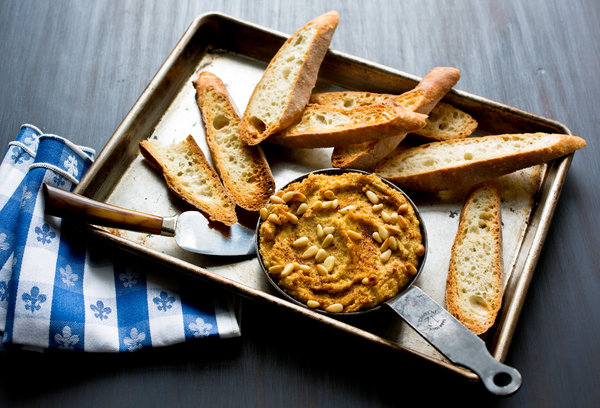
In this comforting Turkish version of hummus the chickpea purée is warmed in the oven and topped with pine nuts. In the authentic version, a generous amount of melted butter would be drizzled over the top before baking. I have substituted a moderate amount of olive oil fo2 garlic cloves
2 cups cooked chickpeas (if using canned, rinse thoroughly)
Salt to taste
1 teaspoon cumin seeds, lightly toasted and ground
1/4 cup extra virgin olive oil
3 tablespoons lemon juice (more to taste)
3 tablespoons sesame tahini
1 tablespoon pine nuts
1/2 teaspoon Turkish red pepper or Aleppo pepper
1. Heat the oven to 400 degrees. Oil a small baking dish or oven-proof bowl. Turn on a food processor fitted with the steel blade and drop in the garlic. Process until the garlic adheres to the sides of the bowls. Turn off the machine and scrape down the sides of the bowl. Add the chickpeas and cumin and turn on the machine.
2. Combine 3 tablespoons of the olive oil, the lemon juice, and the tahini, and add to the machine. Process until the mixture is smooth. Season to taste with salt. Scrape into the baking dish or bowl. Drizzle on the remaining tablespoon of olive oil and sprinkle on the pine nuts and red or Aleppo pepper.
3. Bake for 10 to 15 minutes and serve hot with pita bread.
Yield: 2 cups
Advance preparation: The hummus can be made a day ahead, but don’t garnish it with the olive oil, pine nuts and red pepper until ready to serve. Leftovers will keep for three or four days in the refrigerator.
Nutritional information per tablespoon: 42 calories; 3 grams fat; 0 grams saturated fat; 1 gram polyunsaturated fat; 2 grams monounsaturated fat; 0 milligrams cholesterol; 3 grams carbohydrates; 1 gram dietary fiber; 1 milligram sodium (does not include salt to taste); 1 gram protei
n

For Ye Shiwen, China’s 16-year-old swimming sensation, there was no period of fun or relaxation after winning two golds at the London Olympics. Her parents had promised to take her to Hong Kong Disneyland but it turned out there wasn’t enough time. In early August, on the same day that she returned to Hangzhou, her hometown in eastern China, she got back into the pool and resumed her training. Two months later, while Jamaican sprinter Usain Bolt was bar-hopping in Australia, Ye was racing again in a national competition, broadcast in prime time on China’s top sports channel.
In London Ye found herself at the centre of controversy after she blitzed the field in the women’s 400m individual medley, claiming the world record and beating her personal best by five seconds. There was no evidence that she had ever used drugs but her speed over the final length, which sheswam faster than the 6ft 2in-tall American Ryan Lochte, who won gold in the men’s medley, fuelled intense speculation that she had been cheating. John Leonard, executive director of the World Swimming Coaches Association, lent a voice of authority to the doubts. “Any time someone has looked like superwoman in the history of our sport they have later been found guilty of doping,” he told the Guardian.
The International Swimming Federation came to Ye’s defence, pointing out that she had passed four drugs tests in the past year. Other swimming experts pointed out that Ye’s trademark has always been her flying finish to races.
But for many people in China the speculation touched a raw nerve. It betrayed a “lack of respect for athletes and for Chinese swimming”, according to Xu Qi, the head of China’s swimming team. “We recognise and accept the existence of extremely talented swimmers in other countries. Can’t China, with its huge population, produce such talent?”
. . .

The only physical features that really distinguish Ye are her hands and feet. “When I was six, my kindergarten teacher noticed how big they were and thought I would be well-suited to swimming,” she says. Five years later, aged 11, she was selected for her provincial team, going into competition against women twice her age.One bright autumn day in September, Ye and around 600 of China’s best swimmers gathered in a small arena at the foot of Huangshan, or Yellow Mountain, for a national competition. A one-hour flight from Shanghai, Huangshan is a major Chinese tourist destination, known for its jutting granite peaks. Ye will not, however, be doing any sightseeing. “It’s my first visit here and it looks beautiful, but I won’t have a day off,” she tells me.
At 5ft 7in, Ye is a little shorter than average for female competitive swimmers, and, though her shoulders are broad, they do not bulge. In fact, the most striking thing about her is just how normal she looks. Her face is more remarkable for its baby fat rather than any extraordinary musculature. She looks nothing like the square-jawed, heavily muscled Chinese female swimming champions of the 1990s.
Her coach on the provincial team, Xu Guoyi, 42, a straight-talking man with an easy laugh, was initially unimpressed by her swimming ability. “I figured she had been brought to me through some sort of backdoor connection,” he jokes. “Then little by little I saw that she was able to learn very quickly. Some swimmers fight against the water, others are like fish.”
In Huangshan one morning after training, I join Ye and Xu for lunch at a hotel restaurant near the pool. Swimmers who work out constantly tend to have voracious appetites and Ye is no exception, albeit with Chinese characteristics. She ploughs through a mound of fried noodles, a plate of the local speciality of chouguiyu, or stinky fish, and six braised duck tongues, letting out a little burp at the end.
For all her grace as a swimmer, Ye is still refreshingly rough around the edges in her public image. Chinese athletes are often drafted into the Communist party propaganda machine because their popular appeal gives grey officials a way to connect with China’s youth. Like other Olympic champions, Ye has been paraded in front of the cameras to meet Hu Jintao, China’s president. Unlike others, however, she hasn’t yet mastered the art of the politically correct soundbite. “He asked me if I was 16. I said, ‘Yes,’ ” she says of the meeting. “And then I forget everything after that.”
The responses and statements of Chinese athletes can get lost in translation. After Ye set a world record in the 400m race, she was widely reported in foreign media as having made only the tersest of tweets on her Chinese microblog: “The first day’s competition is finished. The score is satisfactory. Tomorrow I still have the 200m and will continue to strive.” A better translation would have cast her in a much more human light: “First day’s race is over, yay! Extremely pleased with the result, and tomorrow have the 200m, so gotta keep going strong!”
Having won her first major gold medals at the age of 14, at the Asian Games in 2010, Ye is more self-assured than most teenagers. But she still has a girlish streak: stuffed animals dangle from her backpack, and she says one of her favourite pastimes is doing her nails.
She is aware of the constraints her lack of English presents at international competitions. “I get very nervous before races,” she says. “The atmosphere can be oppressive. The other swimmers joke and laugh with each other but I can’t talk with anyone, and I need to chat to relieve the pressure. It’s hard to take.”
I remind Ye of the packed news conference she gave after she won her second Olympic gold when she faced question after question about whether she had used drugs. She fended them off calmly at the time but today says it remains a sore point. “It made me very angry. I put in so much effort only to have my results called into question.”
What made the suspicions about Ye all the more potent is the not-too-distant past of the Chinese swimming team. In the early 1990s China’s women dominated world swimming but their success descended into scandal. Seven Chinese swimmers tested positive for steroid use at the Asian Games in 1994 and another four were banned in 1998 after a teammate was caught smuggling human growth hormones into Australia for the world championships.
The government line in China has usually been to blame drugs use on rogue coaches. But realising that the system itself was part of the problem, national officials in Beijing began to rebuild, purging tainted coaches and introducing regular drug testing.
But just before the London Olympics, the spectre of drugs in Chinese swimming reared up again. In June, the Chinese Anti-Doping Agency announced that Li Zhesi, a member of the women’s relay team that set a world record in 2009, had tested positive for EPO, a performance-enhancing substance used in endurance sports. There was, however, one crucial difference to past scandals: Li had been found out by a domestic test.
“China has had a lot of discussions with other countries about how to control the situation,” says Wang Ping, the main swimming correspondent for China Central Television, the national broadcaster. “The old problems still make people feel a lot of pain and regret.”
China is hungry for external affirmation of its accomplishments in the pool. After I spoke to Wang, he asked if CCTV could interview me about why I was writing an article about Ye. That night, the broadcaster devoted four minutes of its sports news to a report about my meeting with Ye. The message was clear. “China shouldn’t be afraid of suspicions,” says Xu, Ye’s coach. “If we open ourselves up, we’ll prove that our coaches and athletes are OK.”
Both Wang and Xu said that China’s recent achievements in the pool were the result of a confluence of longer-term trends: more investment in sport, more sophisticated training and young athletes who are naturally bigger as the country becomes wealthier.
Money is perhaps the most important element. Li Liyan, a researcher with the General Administration of Sports, the country’s top sports body, estimated that China spent Rmb700m (£70m) per medal won during the 2004 Athens Olympics. Since then, China’s medal count has risen but so has its spending. The national sports budget, set at Rmb3.3bn this year, has been increasing by 10 to 12 per cent a year. Swimming has been a major recipient of all this cash.
China’s training regimen has also tried to adopt some international best practices. Mirroring the government’s economic strategy, the national team introduced a “go out, invite in” policy: sending swimmers abroad to train, while also luring top coaches to China, among them David Lyles, a Yorkshireman who once trained British Olympians and who became the first foreign coach to move full-time to China when he joined the Shanghai swimming team in 2005.
“In Britain you can’t go out and poach swimmers from other clubs. Whereas here I could pick any kid I wanted and train them how I wanted,” Lyles says.
Ye has been a beneficiary, training part-time in Australia under respected coaches Dennis Cotterrell and Ken Wood. “[China] pay four times more than what I get from my Australian swimmers,” Wood told Australian media after Ye’s victories. “It would frighten you if I told you [the amount].”
Still, there is no hiding that the Chinese sports regime is a relic of the Soviet command-and-control approach. Government-run schools assign promising athletes to sports and funnel them up to higher levels as they improve. Children move away from home to focus on their training.
The case of Wu Minxia highlighted how intense this dedication can be. After she won gold in diving in London, Chinese newspapers reported that Wu had not been told that her mother had cancer, and that her grandparents had died, for fear of disturbing her concentration. “Our daughter doesn’t belong to us any more,” Wu’s father told local media.
Ye’s case is less extreme. As Chinese society modernises, the sports system is becoming a little less uptight. Ye may have left home at the age of 11 when she joined the provincial team but at the weekends she normally goes back to her parents’ place.
At sports school, however, she has just six hours of classes in a normal week. In the run-up to the Olympics it was less. Xu cites this a reason for China’s success in the pool. “Compared with other countries, our athletes spend more time training and less time going to school,” he says.
There are other differences with Chinese swimmers. Britain’s swimmers were high-profile flops of an otherwise successful home Games. Last week, British Swimming published a report noting that “commercial distractions” were a factor in their poor performance. Xu says he limits Ye’s commercial deals: “Too many ads are a waste of energy. It would impact her professional development.”
On that sunny autumn day in Huangshan, where the country’s top swimmers had gathered for a national competition, Ye’s coach had decided to ease the pressure on her by entering her in events that she normally does not compete in and so was not expected to win. Coming so soon after the Olympics, it was a chance for lesser names to demonstrate their abilities. Some are as young as 13, and one competitor is wearing a Mickey Mouse swimming cap.
Ye Shiwen©Andrew Rowat
In the training session, around 50 swimmers plunge into the water at a time. It calls to mind the Chinese phrase commonly used to describe crowded public pools: xiang xia jiaozi (like boiling dumplings).
There are 29 teams from China’s biggest provinces and cities, as well as the army and the navy. The results will help determine their place in the national system. “Chinese athletes feel pressure to do well not just from their country but also from their provincial team,” Wang, the TV commentator, explains.
A small roar goes up from the crowd of a thousand when Ye is introduced. Loud dance music pulsates in the arena and cigarette smoke wafts into the pool area as coaches huddle near the entrance puffing away.
The day before at lunch, I had asked Ye if there were times when she ever wanted to stop swimming. “Yes, I think about that often because it’s so painful,” she replied. “Physically, it’s exhausting, and psychologically, too.”
The 50m freestyle race is over in a flash. Wearing a black swim suit and a bright red cap, Ye swims it in 25.74 seconds, a personal best and three seconds faster than her famous final length at the Olympics. But this is a single-length sprint and her time is only good enough for fourth. Ye shuts her eyes when she sees the results. The winner, Yin Fan, had just missed a spot on the team at London.
Climbing out of the pool, Ye manages a faint smile and tells the scrum of journalists facing her that she is not worried about missing the podium.
Though swimming nearly every day since the Olympics, she has also had a busy roster of public appearances. It is time to turn up the intensity again. Her plan is to start by going to a high-altitude facility in the southwest of China to improve her fitness. “My training recently has not been very systematic.”
Simon Rabinovitch is the FT’s Beijing correspondent
Additional reporting by Emma Dong

Powered by Blogger.